

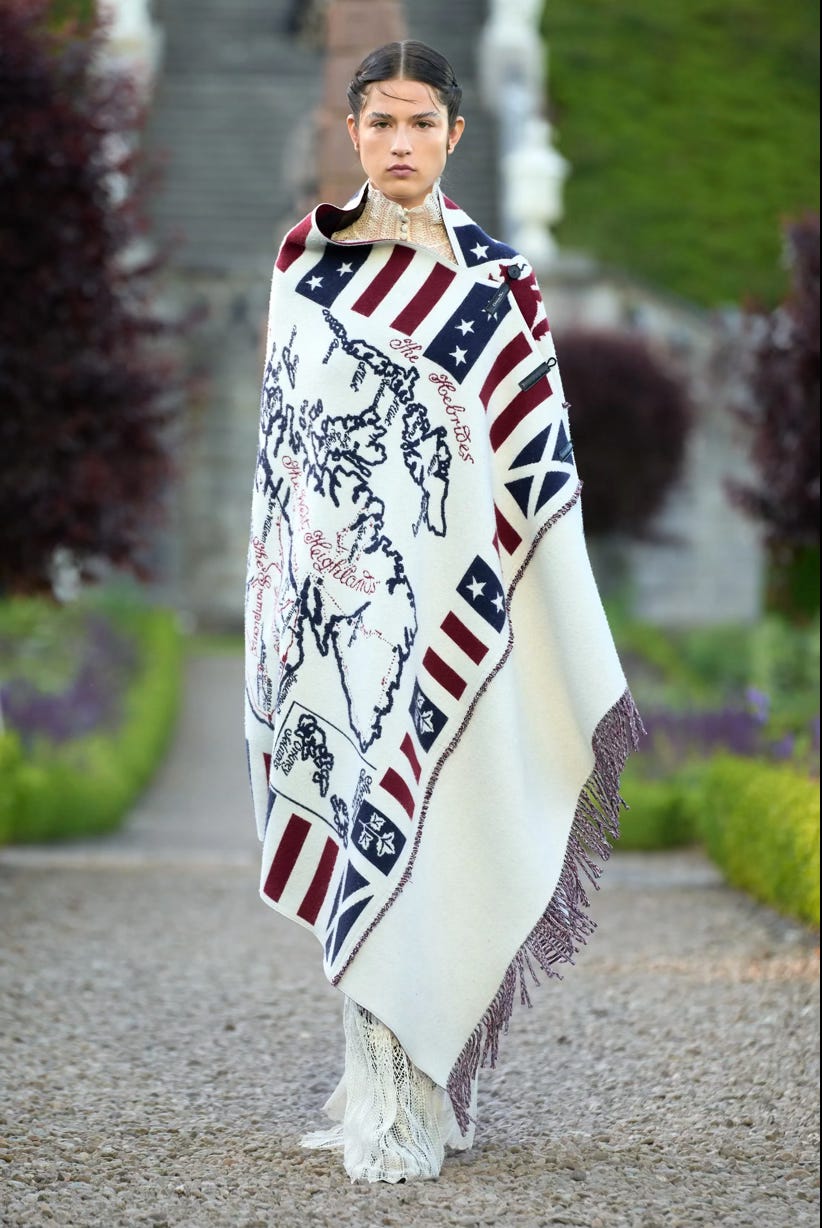
Have you watched the recent Dior Cruise show? Tears started flowing as I listened to the skirl of bagpipes, because I’m actually quite sentimental. Walking ahead of the models, the bagpipe player was clad in a red gown, her hair twisted in a warrior braid. She opened the show walking around, as the pipes echoed through the grounds of Drummond Castle in Perthshire, Scotland,
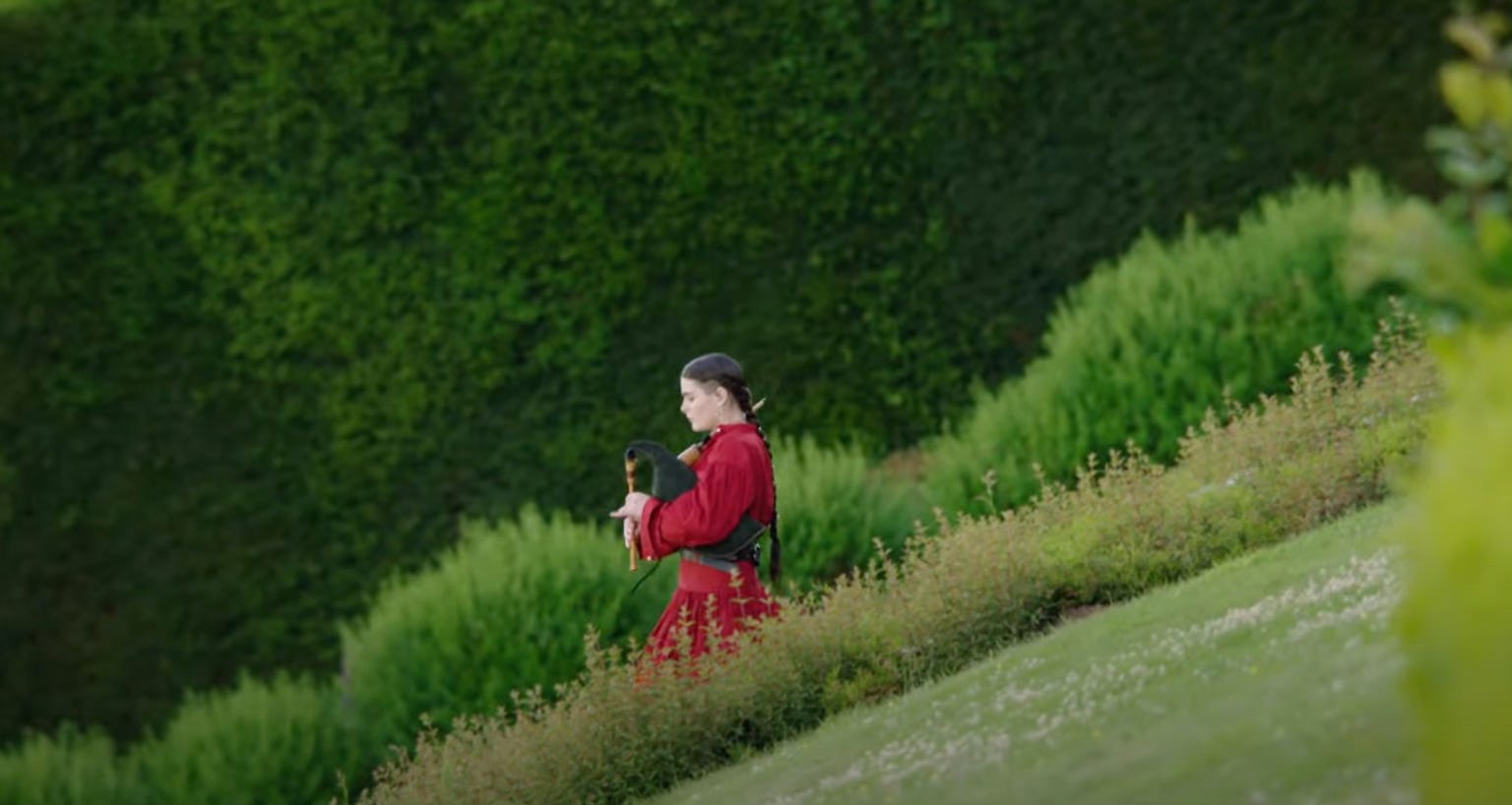
My best friend, who is Scottish, messaged me immediately to ask me if I had worked on the show? No, I was merely thousands of miles away, wishing I could have been there to witness it in real life.
If you’ve read some of my other pieces, it will be no surprise that I'm not a fan of Dior, but this collection was actually stunning, if a bit large. I am, however, terribly biased as I adore tartan, Scotland and folk history. So if there was ever a show that would tug at my heartstrings, this would be the one.
I thought there were many wonderful re-workings of the cloths from tartan to argyle and plaid. The bold purple opening dresses, with frayed edges completed by a Dior Sporran of sorts. Look 5, a transparent black tartan fringe dress, made my granny goth heart skip a beat. Nyaduola and Rejoice in chain mail armorial dresses, a nod to Scotland's bloody history.
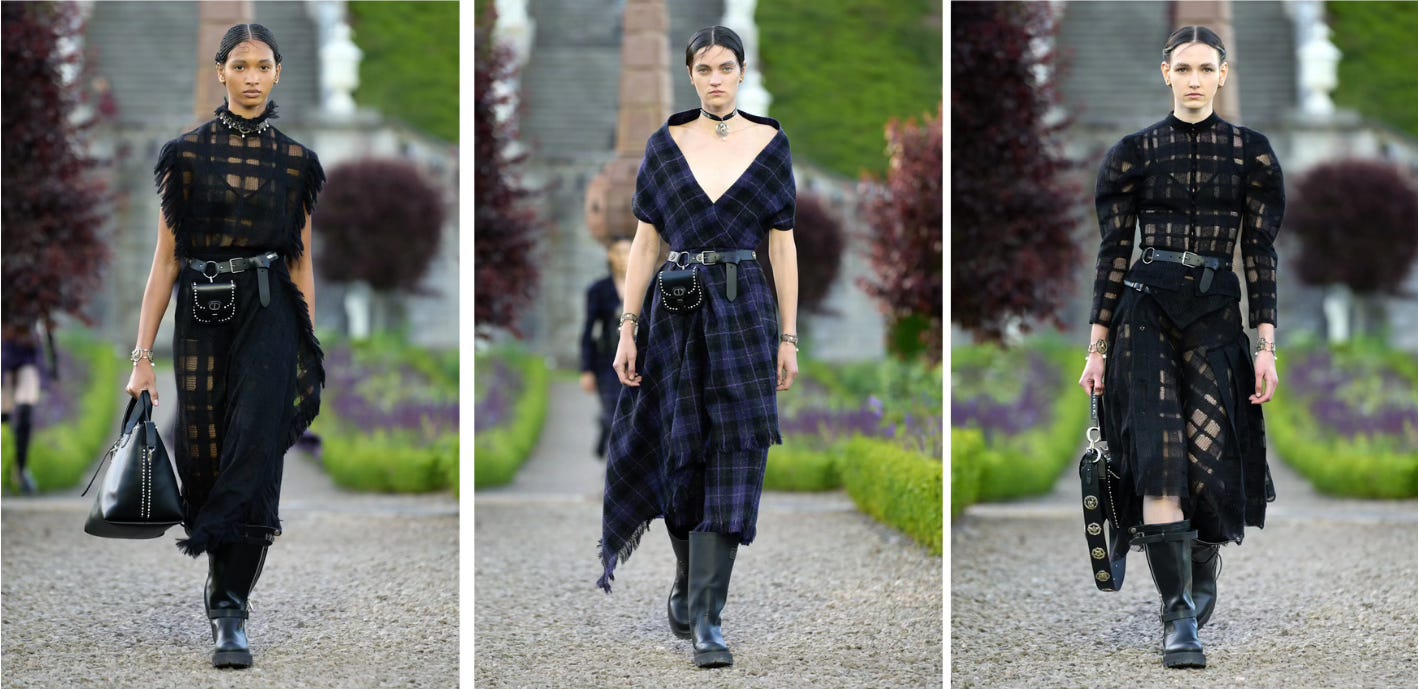
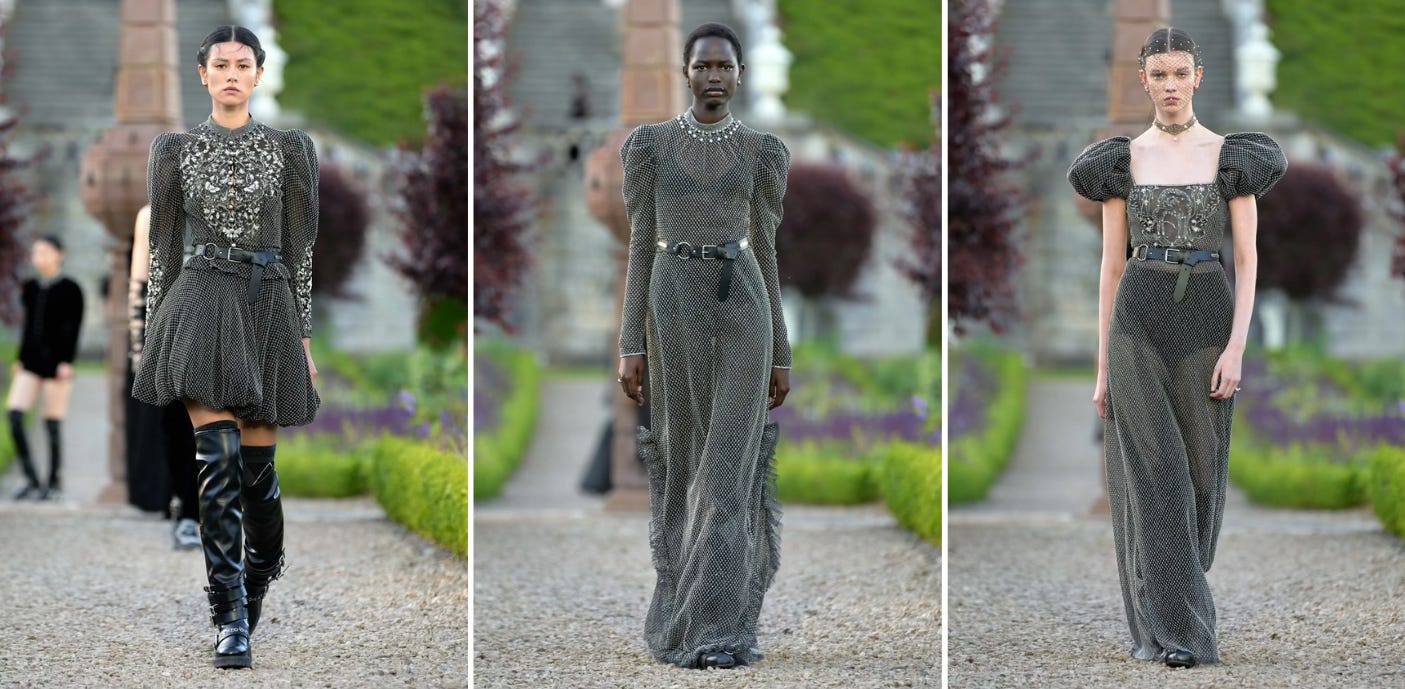
And here I couldn’t help but wonder, where the line between tartan and tartanry would be drawn. A quick history lesson, or a few episodes of Outlander would teach you that the subjugation of the Scots, by the hand of the English, was bloody and brutal. The infamous battle of Culloden in 1745, where over a thousand men lost their lives fighting for the Scottish rebellion, marked the beginning of the end for much of Scottish culture. There is some debate around whether the tartan, which distinguished each clan from another, was banned in the 1746 act of Proscription, but nevertheless attempts to erase traditional culture remain an undeniable part of Scottish history.
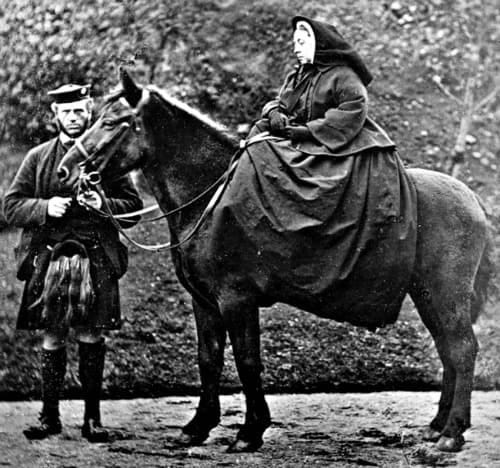
However perversely tartan, which at various times and in various ways was met with disgust and described as barbaric, became a symbol of not just Scottishness but also British Imperialism. In 1822 Sir Walter Scott, King George IV, and European Romanticism collided and began to change the perception of Scotland's rebellious past by refocusing the narrative to notions of beauty and romanticism propped up against dramatic landscapes. This and the overzealous interpretations of tartan. When Queen Victoria purchased Balmoral castle, she also apparently had the walls, floor to ceiling draped in tartan. This is tartanry, both sentimental and vulgar. It bypasses any reality of the subjugation of the Highlanders at the hand of the crown, and romanticizes the parts of Scottish culture which the institution finds acceptable.
What Chiuri did so well in her recent collection, which was clearly well researched, was incorporate the geopolitics and history of the country without only focusing on the fabrics. There were elements of romanticism but also toughness to the collection. These nods to Scotland's true history, not the romantic version of the country which has been crafted and perpetuated by visitors.
My Scottish friend Bryony, reminds me that she has no knowledge of her own language. The myth is that post Culloden the act of Proscription banned Gaelic, which is untrue according to the act itself. However what was law and what was done about it are two different things. The eclipse of Scottish Gaelic however can be traced much further back than 1746. As early as 1070 the Scottish King Malcolm III married princess Margaret of Wessex, an Anglo-Saxon who refused to give her children Gaelic names, and is credited with anglicizing the Scottish court. Her sons went on to overthrow their uncle “the last Celtic King of Scotland”, and take the throne as legitimate heirs, albeit English ones. History is peppered with small but powerful moments like these, where the English slowly gain more and more control over Scottish culture.
And your question might be, what does this have to do with tartan? With fashion? Everything, I say.
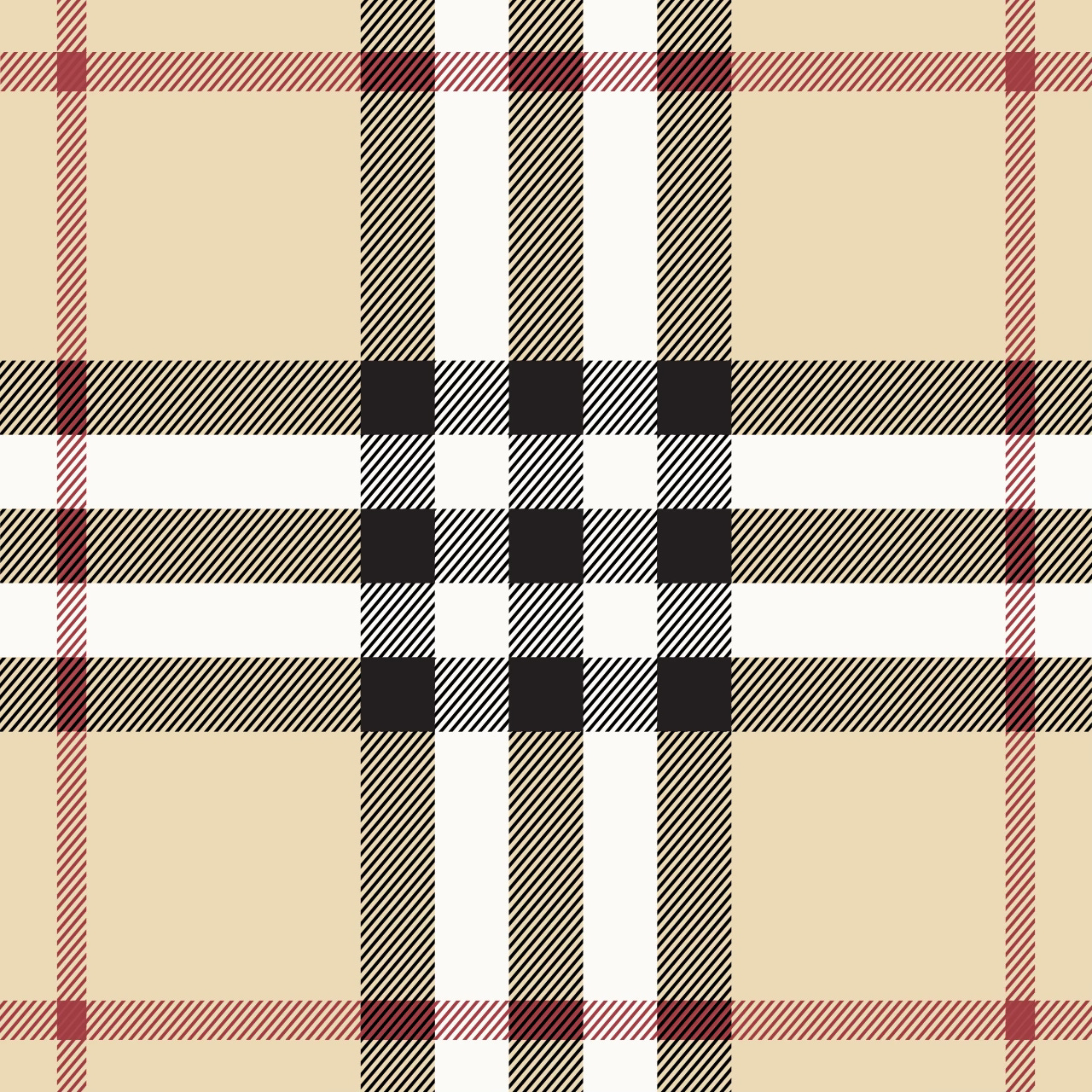
Tartan, Plaid and Argyle, although all Scottish, have long been used by English fashion brands as heritage markers of quintessential Britishness. And this does matter. Thomas Burberry, an Englishman from Hampshire, founded the brand in 1856. He created and trademarked The Burberry “check” which was “inspired” by Scottish tartan, but I dare you to find the difference. Today entire collections of “check” trousers, coats, skirts and more are created by the brand.
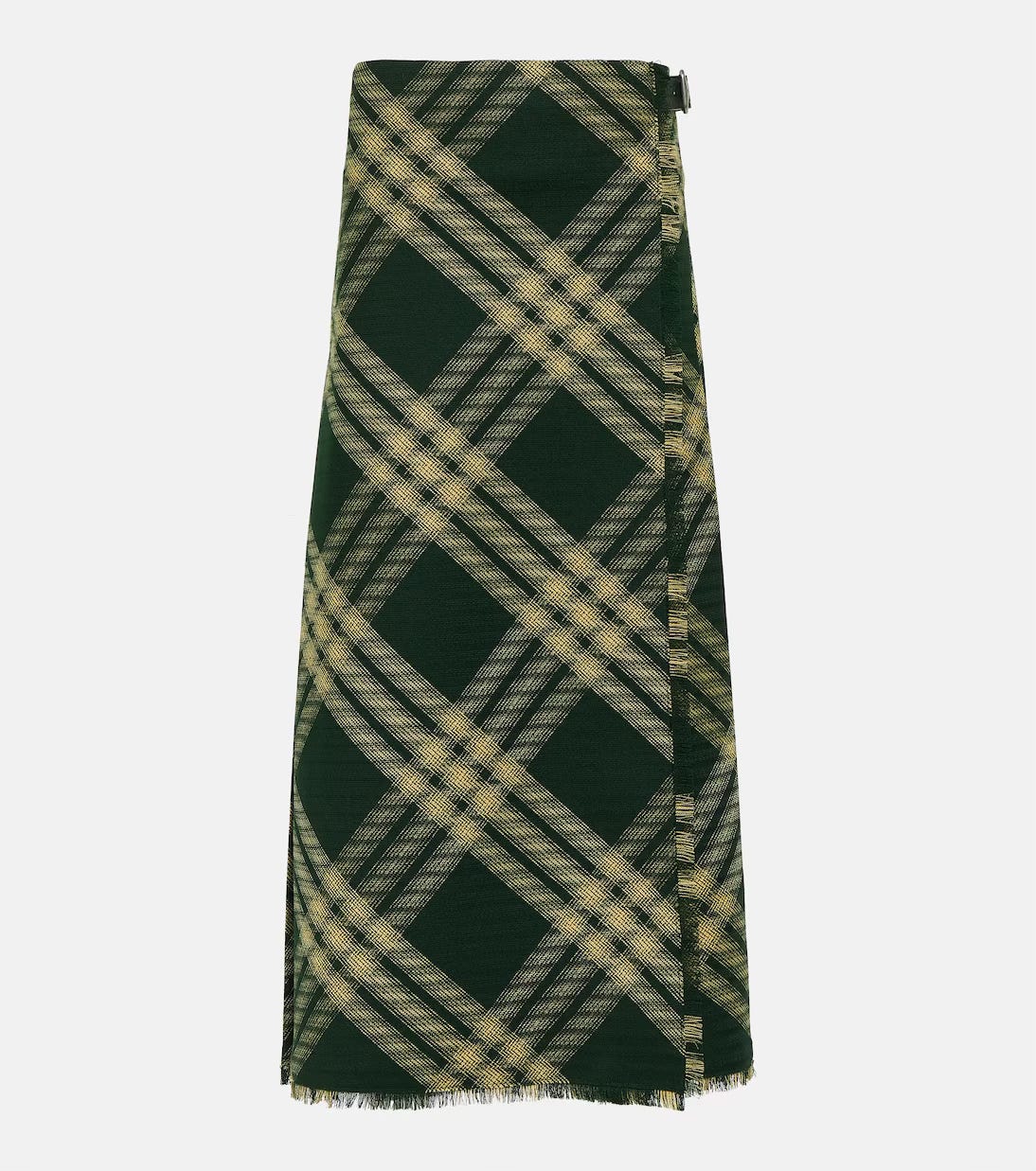
“The thing is Silv…” Bryony continues, “Its all very good and well coming to Scotland and having a beautiful show, but they are taking something which is inherently ours and making a shit load of money off it”. She has a point. Chiuri worked with local craftsmen and women such as Johnston of Elgin, ESK Cashmere, Le Kilt and ceramicist Pollyanna Johnson, for the creation of this collection, which is a worthy gesture. This is not personal, it’s about the wider context. From a design perspective I believe Chiuri went to great lengths to research and pour the history Scotland into her collection, and we can accept that as cultural appreciation. However there is also Dior the business, who will profit on the interpretation of a piece of Scottish culture.
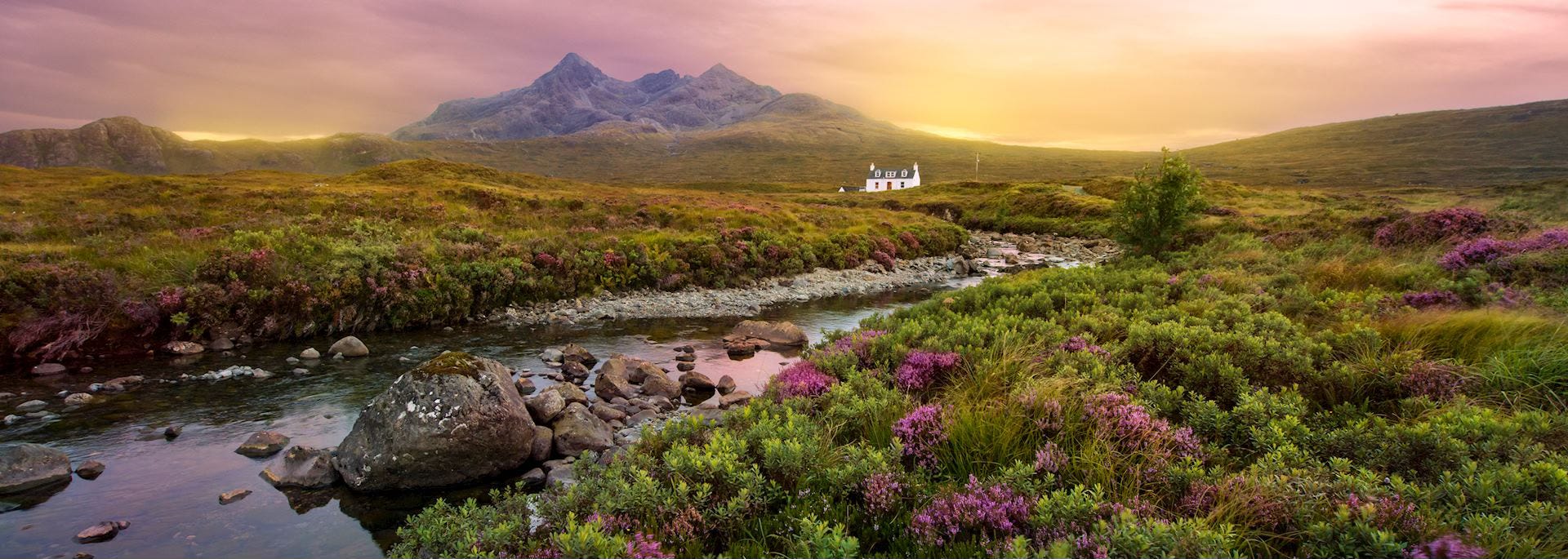
Her frustration is at the representation of Scotland as a land of enchanted Glenns, fairy pools, Gothic architecture, and the tourists of Scottish descent turning up to Waverley station wearing their ancestors' clan tartan without any acknowledgement of the cultural repercussions on the people who actually live there. This is not unique to Scotland, many parts of the world are used as a playground by British and foreign tourists. Hotels, restaurants, and other businesses which service tourist needs are abundant, but local councils are impoverished and underfunded, doing nothing for local communities. The Lake District being one such place. Also romanticized to the point of belonging more to tourists than the locals who have lived there for generations.
The question is not about whether or not you can wear tartan, the answer is yes! There seem to be only a few tartans which are banned, most ironically the Balmoral tartan which can only be worn by the Royal Family. Other restricted tartans usually belong to clans, and more rightfully you should only be given permission to wear these. However there are plenty of what are called “universal” tartans which can be worn.
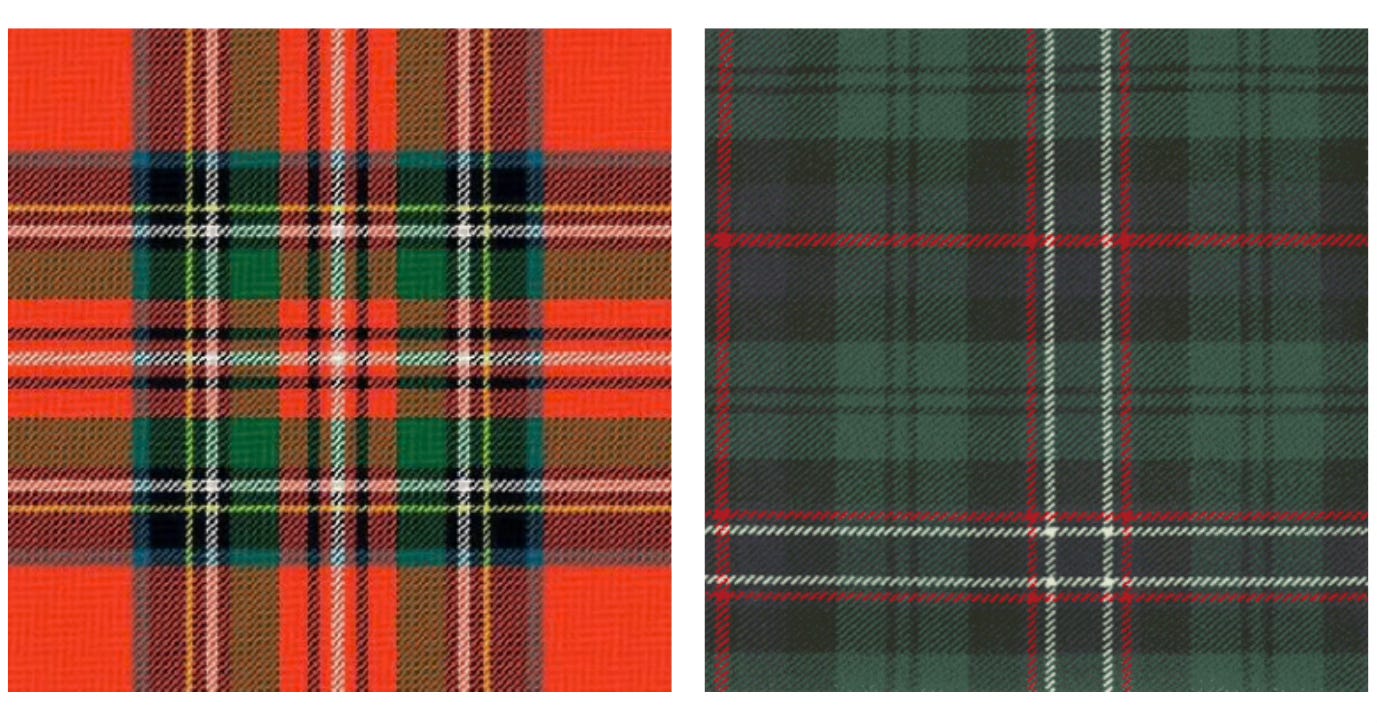
The sticking point for Bryony is “I think we just want the acknowledgement of what happened to us to be known, not just for people to come here and take what they like without taking the time to understand the consequences of history”. At this point she was a bit emotional so I said “Imagine the War Chief of Clan Mackenzie, who died by arrow in 1745 on Culloden moor, watching the Dior show from the heavens” (pure fiction by the way), she giggled hard and thought perhaps he would be laughing, for no matter how much the Empire tried to erase Highland culture, the spirit of Scotland is celebrated and now lives on.